Built for the Bluster: Protect Your Awnings from Ottawa Storms
Homeowners in Ottawa love the comfort of a shaded patio—but they also know how quickly a calm day can turn chaotic. If you’ve lived here long, you’ve experienced it: gusty afternoons, sudden thunderstorms, unpredicted microbursts, and of course, the infamous 2022 derecho, one of the most destructive wind events in the region’s history.
So it’s natural to wonder:
“How much wind can an awning withstand?”
“Is a retractable awning safe in Ottawa’s weather?”
“Does a wind sensor really work?”
This guide explains exactly how modern retractable awnings—including the models we install at Jans—protect themselves using engineering, automation, and advanced wind-sensing technology.
Ottawa’s Weather Challenge: From Gusts to Derechos
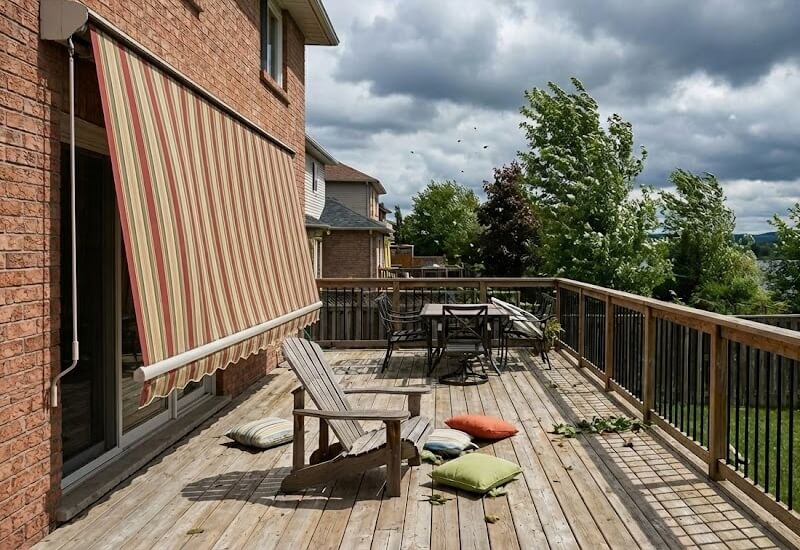
Ottawa’s weather is unlike that of almost any other major Canadian city. Blue skies can turn into 90 km/h gusts in minutes. Summer thunderstorms are notoriously explosive. And large-scale events like the 2022 derecho remind homeowners that severe wind is a reality—not a possibility.
To put this into context, the Beaufort Wind Scale classifies winds around:
- 29–38 km/h as “strong breeze”
- 39–49 km/h as “near gale”
- 50–61 km/h as “gale”
Even “strong breeze” levels can stress an unprotected awning—especially if it’s fully extended. That’s why modern retractable awnings rely on wind sensors and engineered frames to stay safe.
How Does a Wind Sensor Work? The Technology Explained
A retractable awning’s wind rating depends heavily on how quickly it can respond to unsafe conditions. Sensors—especially those designed by Somfy, the global standard in smart awning automation—are built precisely for that purpose.
Understanding Anemometers and Accelerometers
Wind sensors generally fall into two categories:
- Anemometer-Based Sensors
These measure wind speed directly using spinning cups (like a miniature weather station). When the air moves quickly enough, the sensor triggers the awning to retract. - Accelerometer-Based Sensors
These measure motion or vibration on the awning’s front bar. If the awning begins shaking beyond a safe threshold, the sensor sends a signal to retract.
Somfy’s Eolis Wind Sensor and Soliris Sun/Wind Sensor use these principles. They’re wireless, low-maintenance, and extremely reliable.
Setting Sensitivity Thresholds
Sensors can be programmed to retract the awning at specific wind levels. Most are set to retract somewhere between:
- 20–28 km/h for fabric protection
- 28–38 km/h for frame protection
- Automatically if vibration exceeds the safe range
This gives homeowners real peace of mind—especially when they aren’t home.
Peace of Mind: The “Automatic Retraction” Feature
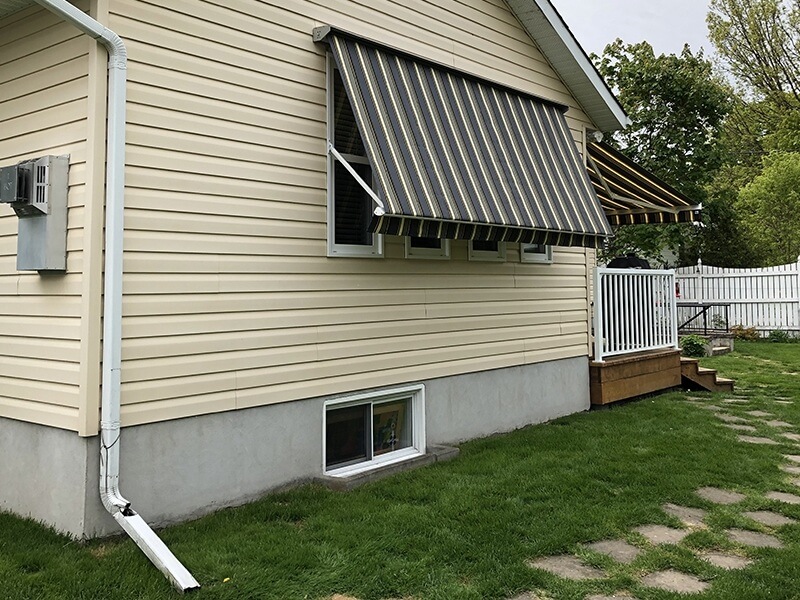
Automatic retraction is the most powerful protective feature for Ottawa homeowners.
When wind crosses the programmed threshold, the sensor immediately:
- Detects unsafe motion or wind speed
- Sends a signal to the motor
- Retracts the awning without requiring homeowner action
It’s the equivalent of having someone standing outside watching your awning at all times.
And because the system is wireless and self-powered (often solar), it remains functional even during a power outage.
This is especially valuable during sudden Ottawa storms, which can develop in under five minutes.
Learn more about our retractable awnings.
Beyond Sensors: The Importance of a Well-Built Frame
While sensors provide automated protection, true durability depends on the engineering of the awning itself.
A sensor can only save the awning before wind reaches dangerous levels. The awning must be built to handle day-to-day breezes even when partially extended.
Forged Components vs. Cast
High-quality awnings (including the ones Jans Awnings and Rollshutters installs) use:
✔ Forged arms instead of cast aluminum
✔ High-tension springs for fabric stability
✔ Reinforced front bars
✔ Stainless steel fasteners
Why this matters:
Forged components flex under stress while cast components crack. That flexibility is critical when the wind suddenly gusts.
The Role of Professional Installation in Wind Resistance
Even the strongest awning can fail if installed poorly.
Professional installation ensures:
- Proper mounting into structural supports (not just brick veneer)
- Correct pitch angle for wind deflection
- Secure anchoring that resists torque forces
- Precise tensioning of arms and fabric
A retractable awning with a high wind rating is only as strong as its installation.
Is a Wind Sensor a “Nice-to-Have” or a “Must-Have” in the Ottawa Valley?
If you live in Ottawa, Gatineau, or the surrounding area, the answer is simple:
A wind sensor is a must-have.
Here’s why:
- Ottawa’s weather is unpredictable
- Storms often develop while homeowners are away
- A single gust can cause thousands of dollars in damage
- Home insurance often does not cover storm damage to awnings
- A wind sensor adds years to the life of your awning
- It protects your investment automatically, 24/7
For a relatively small additional cost, homeowners get long-term protection, automation, and total peace of mind.
Final Thoughts: Built for Ottawa. Built for Real Weather
Your patio should be a place of comfort—not stress. High-quality retractable awnings equipped with automatic wind sensors are engineered precisely for climates like Ottawa’s.
They’re strong. They’re smart. And they’re specifically designed for environments where wind can go from mild to menacing in seconds.
Don’t leave your investment to chance. At Jans Awnings and Rollshutters, all our motorized awnings can be equipped with industry-leading wind protection.
Contact us today to learn more about wind sensors and motorized awnings, or request a quote.
Protect your patio. Protect your home. And enjoy worry-free outdoor living—no matter what the Ottawa sky brings.