Privacy Screen Zoning Rules in Ottawa: Retractable Screens vs. Permanent Backyard Privacy Walls
If your backyard feels like it has become part of the neighbourhood’s viewing area, you’re not alone.
In many Ottawa communities—including Kanata, Barrhaven and Orleans—homes are built on relatively compact lots, often with neighbours only a few metres away. Add a second-storey window overlooking your deck or patio, and a standard backyard fence may do little to provide the privacy you actually want.
That naturally leads to a common question: “Can my neighbour build a privacy wall higher than the fence line in Ottawa?”
The answer depends on what is being built, where it is located and which City of Ottawa rules apply. A conventional fence is not necessarily regulated in the same way as a deck, balcony, accessory structure or a screen incorporated into another outdoor feature.
This distinction matters when you’re considering a permanent privacy wall versus a retractable privacy screen.
The Backyard Seclusion Challenge: Tight Suburban Lots and Close Neighbours
Backyard privacy in Ottawa isn’t always about blocking the view at ground level.
A conventional fence can screen your yard from a neighbour standing nearby, but it may do almost nothing against sightlines from a second-storey bedroom, balcony or elevated deck.
At the same time, homeowners don’t necessarily want to build a tall, permanent wall. A solid structure can make a small backyard feel even smaller, block sunlight and create a significant visual barrier.
There’s also the practical issue of Ottawa’s seasons. You may want complete privacy during a summer dinner or while relaxing in a hot tub, but prefer an open yard when you’re gardening, enjoying winter sunshine or entertaining with friends.
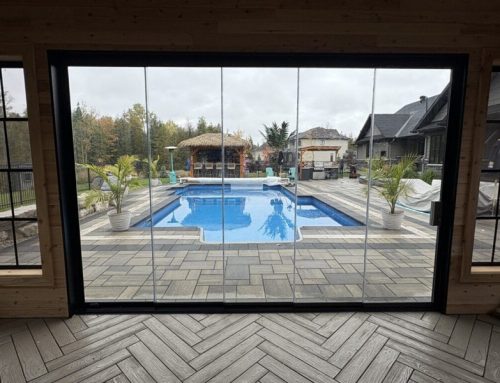
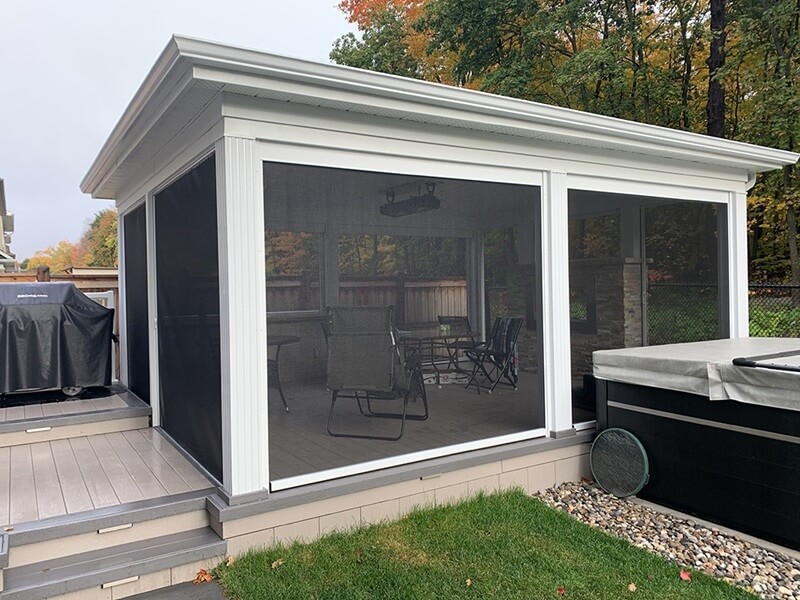
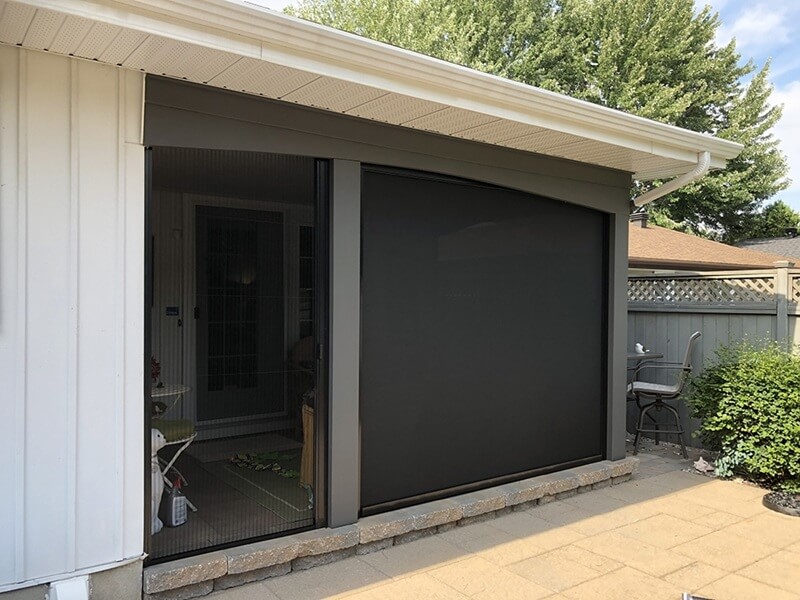
This is where retractable privacy screens can offer an alternative approach. Instead of creating a permanent partition along the property line, a motorized or manually operated screen can be integrated into an existing outdoor living space. The screen can be extended when privacy is needed and retracted when it isn’t.
However, there’s an important distinction to make before installing one: a retractable screen is not automatically exempt from every municipal requirement simply because it retracts.
The exact installation matters.
Understanding City of Ottawa Fence and Privacy Wall Height Restrictions
If you’re researching Ottawa fence and privacy screen height bylaws, start with the rules that actually apply to fences.
The City of Ottawa currently states that residential fences may not exceed 1 metre in a front yard or 2.13 metres in any other yard. The City also has rules concerning gates, archways and decorative caps.
The City’s landscaping guide similarly identifies a maximum residential fence height of approximately 2.1 metres in back and side yards. It also advises homeowners to confirm property lines before installing a fence and notes that fences cannot be placed in the City’s right-of-way.
That gives you an important starting point—but it doesn’t answer every privacy-screen question.
Why?
Because not every privacy treatment is necessarily a fence.
Ottawa’s zoning regulations separately address features such as decks, balconies, porches, verandas, awnings and accessory structures. For example, the City’s zoning provisions include specific requirements for opaque screens associated with certain decks and balconies near interior lot lines.
That means you should not assume that a screen mounted to a pergola, covered deck or other structure automatically falls outside municipal regulations. Nor should you assume that it is automatically treated exactly like a conventional fence.
The configuration needs to be assessed in context.
Property-line issues are particularly important. Before installing a permanent structure—or attaching a screen system to an outdoor structure—you should confirm where your property ends and understand any applicable setbacks, easements and zoning requirements.
When in doubt, consult the City of Ottawa or a qualified professional before installation.
The Legal Loophole: How Retractable Privacy Screens Can Offer More Flexibility
Calling a retractable privacy screen a “legal loophole” is tempting, but it’s not quite accurate.
A retractable screen isn’t a magic exemption from Ottawa bylaws. Its advantage is that it can be a fundamentally different type of outdoor feature from a permanent fence or privacy wall.
The way the system is mounted, its dimensions, its location, and the structure supporting it can all affect which rules apply.
That distinction can make retractable screens particularly attractive for homeowners who want privacy without constructing a new permanent boundary.
Permanent Wooden/Stone Boundaries vs. Adaptable On-Demand Mesh Walls
A conventional privacy wall is, by definition, permanent.
Once installed, its height, location and visual impact remain essentially the same whether you’re using your patio or not.
A retractable privacy screen takes a different approach.
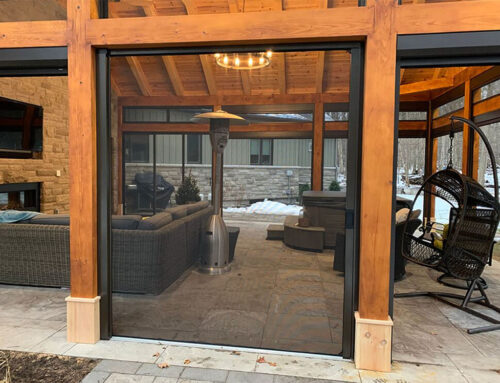
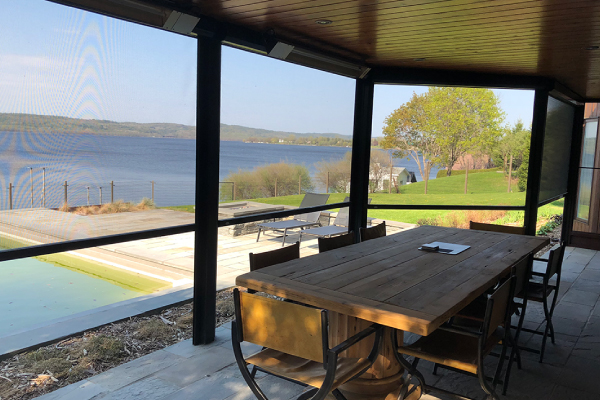
The screen can remain housed against a post, wall or header when you don’t need it. When your neighbours are outside, you’re hosting dinner or you simply want some solitude, the retractable privacy mesh can be extended across the opening.
This provides several advantages:
- Flexibility: You can choose when privacy is needed.
- Visual openness: When the screen is retracted, your backyard remains open and connected to the surrounding space.
- Seasonal usability: The screen can provide privacy during the months when you’re spending the most time outdoors without creating a permanent visual wall.
- Integration: A properly designed system can become part of a pergola, covered deck, porch or other outdoor living area rather than looking like an additional fence installed along the property line.
- Potentially fewer property-line conflicts: Because the objective is to create privacy within your outdoor living space rather than construct a new boundary, there may be more flexibility in how the system is positioned. That does not eliminate the need to verify applicable zoning requirements.
The important point is that retractability alone does not determine legal status. Don’t rely on a generic claim that every retractable screen is automatically exempt from fence-height rules.
The safest approach is to have the proposed installation evaluated based on its actual design.
Maximizing Sun, Wind, and Visual Isolation with Translucent Performance Fabrics
Privacy doesn’t have to mean turning your backyard into a dark box.
Modern retractable systems can use performance fabrics designed to balance privacy, sunlight and airflow.
Depending on the fabric selected, a screen can reduce direct visibility while still allowing some natural light through. This can be particularly useful in Ottawa backyards where a solid wall could significantly change the feel of the space.
For example, a homeowner might want:
- Privacy from a neighbour’s second-storey window
- Reduced glare during afternoon entertaining
- Protection from breezes
- A more comfortable shaded seating area
- Some separation from nearby patios without completely blocking the view
The fabric selection therefore matters just as much as the size of the screen.
A more open-weave fabric may preserve more daylight and airflow while reducing visibility. A more opaque material can provide stronger visual separation.
Motorization can also make the system considerably easier to use. Instead of manually securing a large screen every time you want privacy, a motorized system can be extended or retracted with the push of a button.
For homeowners interested in combining privacy and sun control, explore our retractable shades.
Installation Profiles: Mounting to Pergolas, Accent Posts, or Covered Decks
One of the biggest advantages of a custom retractable system is that it can be designed around the architecture you already have.
A screen might be installed:
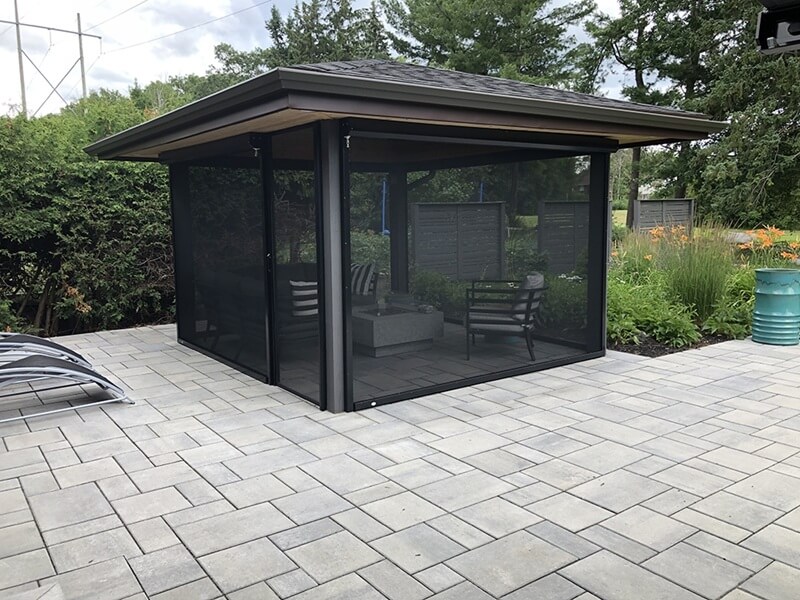
- Between structural posts on a pergola
- Between purpose-built accent posts
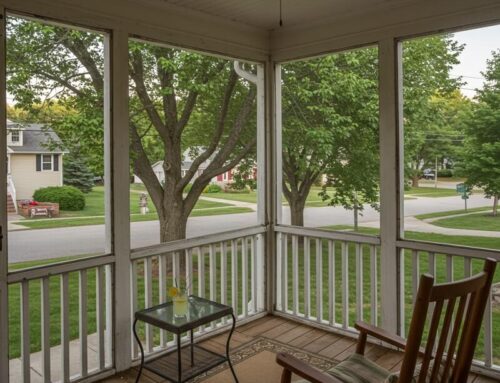
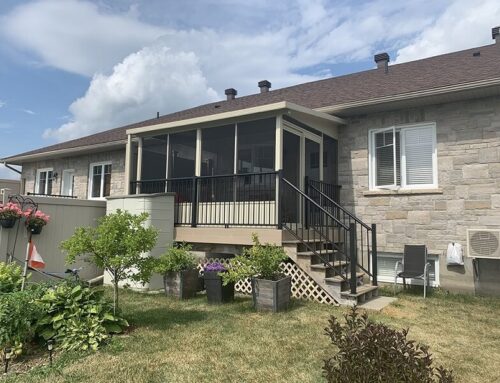
- Beneath a covered deck or porch header
- Along an outdoor seating area
- Within an existing covered outdoor room
- As part of a larger retractable shade installation
This is where professional design becomes particularly valuable.
The supporting structure needs to be appropriate for the screen system, especially in Ottawa’s wind, snow and seasonal weather conditions. The installer also needs to consider the location of posts, attachment points, screen travel, drainage, clearance and the relationship between the installation and property boundaries.
If you’re building a new outdoor entertaining space, Jans Awnings can also incorporate privacy into the design from the beginning. Explore pergola products or retractable screen systems.
And if you’re dealing with a deck, patio or pergola that already exists, a custom screen may allow you to improve privacy without rebuilding the entire outdoor area.
How High Can a Privacy Screen Be in an Ottawa Backyard?
There isn’t one universal answer to the question “How high can a privacy screen be in an Ottawa backyard?”
If you’re talking about a conventional residential fence, the City of Ottawa’s stated maximum is 2.13 metres in a rear or side yard.
But if you’re talking about a screen incorporated into a deck, balcony, pergola, porch, covered structure or another outdoor feature, additional zoning provisions may apply.
For example, Ottawa’s current zoning provisions require a 1.5-metre-high opaque screen in certain circumstances where a deck or balcony is close to an interior side lot line in neighbourhood zones.
This is exactly why copying a neighbour’s privacy wall—or assuming that a particular height is permitted because you’ve seen it elsewhere—isn’t necessarily a reliable way to determine what you can install.
Your lot, zoning designation, structure and installation location all matter.
What About a Neighbour Building a Higher Privacy Wall?
This is another common Ottawa question.
If your neighbour is installing a new fence, privacy wall or other structure that appears unusually high, don’t assume it is automatically illegal—or automatically permitted.
The first step is determining what the structure actually is.
A fence may be subject to the City’s fence-height requirements. A deck, balcony, accessory structure or other feature may be governed by different provisions. Ottawa’s zoning bylaw contains separate regulations for accessory buildings and structures, including height and setback requirements.
If you’re concerned about a proposed structure on an adjacent property, you can contact the City to ask which regulations apply.
For your own backyard project, however, the better strategy is to design privacy into a compliant outdoor structure rather than trying to find a way around a regulation after construction begins.
Why Retractable Privacy Can Be the Smarter Backyard Solution
The biggest advantage of a retractable privacy system isn’t that it supposedly “beats” Ottawa’s bylaws; it’s that you don’t necessarily need a permanent wall to get the privacy you want.
You can create an outdoor room that changes depending on how you’re using it.
Screen open: sunlight, airflow and an unobstructed backyard.
Screen closed: privacy, shade and a more secluded outdoor living space.
That flexibility can be especially valuable on compact Ottawa lots, where every square metre—and every bit of natural light—matters. It also means you aren’t committing your entire backyard to a permanent visual barrier simply because you want privacy for a few hours each day.
Is a retractable privacy screen considered a fence by Ottawa bylaws?
Not necessarily. A retractable screen should not automatically be assumed to be a fence simply because it provides privacy.
Its classification and the rules that apply can depend on how and where it is installed. Ottawa regulates conventional residential fences separately, while its zoning bylaw also contains provisions affecting decks, balconies, accessory structures and screens.
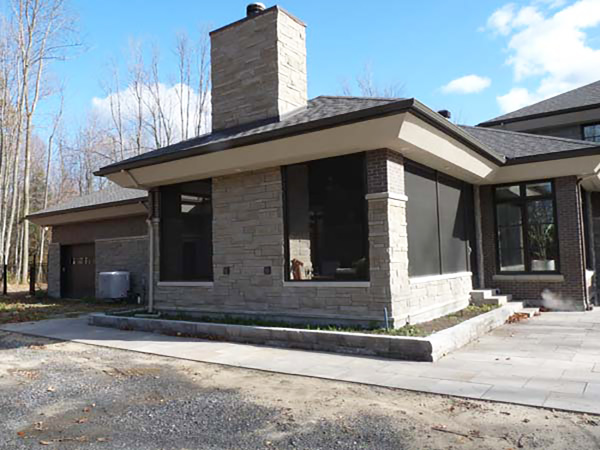
A retractable screen mounted under a porch header or integrated between pergola posts may be treated differently from a permanent fence constructed along a property line—but that does not mean every such installation is exempt from municipal requirements.
Before installing a taller screen, confirm the proposed design with the City or a qualified installer familiar with Ottawa requirements.
How high can a privacy screen be in an Ottawa backyard?
For a conventional residential fence, Ottawa’s stated maximum is 2.13 metres in a rear or side yard.
For a privacy screen associated with another structure, such as a deck or pergola, the answer depends on the specific installation and applicable zoning rules.
This is one reason custom design is important. The question isn’t simply “How high can I make my screen?” but rather “What type of structure is this, where will it be located, and what rules apply to that configuration?”
Privacy Without the Permanent Wall
Ottawa homeowners shouldn’t have to choose between an exposed backyard and a giant permanent privacy wall.
Retractable screens provide another option: privacy when you need it, openness when you don’t.
For homeowners in Kanata, Barrhaven, Orleans and communities throughout Ottawa, that flexibility can make a significant difference—particularly when neighbouring homes have elevated decks or second-storey sightlines.
Before making changes, however, always confirm current City requirements, property lines, setbacks and any applicable zoning provisions. Municipal rules can change, and the treatment of a specific installation depends on its design.
For current municipal information, consult the City of Ottawa’s property and fencing regulations and its current Zoning By-law.
Get perfect backyard isolation without the legal headache. Contact Jans Awnings & Rollshutters to design a compliant, custom retractable privacy layout.